The science behind the AI attractiveness test
At AttractivenessTest.com, we are passionate about the intersection of technology and human perception. Our goal is to provide a transparent platform that demystifies the science of attractiveness. This page walks through what that research shows, how our AI reads a face from a single photograph, and the background information our technology is built on.

What research says about attractive faces
Start with a blunt question: do people actually agree on who is attractive? Across a surprising sweep of studies, the answer is mostly yes. People lean toward faces that are symmetrical, close to the average of their local population, clear skinned and healthy looking, with the proportions you would expect for a given age and sex. When researchers tested this across five very different populations, the same preferences kept turning up, even though they were not perfectly identical from one place to the next.[1]
Why would taste line up this way? The leading explanation is that these cues once carried information about health and fertility, so a pull toward them was useful long before anyone thought to rate a photo. That does not crown any single face, and plenty of striking people break every rule. But it does mean attractiveness has a shape to it. It can be measured and studied rather than only argued over.
Reading a face from a photo
So how do you turn a photograph into a number? Mostly it is a computer vision problem, and it runs in stages. The first job is humbler than it sounds: find the face, crop it away from the background, and line it up the same way every time. That single step does more work than people realise. In one well known experiment, different photos of the same person varied so much that strangers took them for different people, and just swapping which picture you use can flip an attractiveness rating outright.[6] Even the gap between the camera and the face plays tricks, since a lens held up close quietly distorts the features and shifts how trustworthy and attractive someone looks.[7] Consistent framing is what keeps the camera from casting the deciding vote.
Worth sitting with: across studies, two photos of the same person can differ more in rated attractiveness than photos of two different people. The image you pick genuinely changes the result, which is why clean, consistent cropping has to come first.
Once the face is isolated, the system drapes it in a dense mesh of points, often several hundred, following the eyes, brows, nose, lips and the line of the jaw. Doing this quickly and accurately from ordinary video was a genuine research milestone,[8] and the geometry it produces is a stable, math friendly description of structure and proportion that survives changes in pose and lighting.
That description then feeds a deep neural network trained on thousands of faces that people have already rated. Reviews of the field trace how convolutional networks, and more recently vision transformers, have steadily closed the gap with human judgement,[9] and the newest models keep inching the accuracy higher.[10] The network is not memorising faces. It learns the patterns that track with human ratings, then applies them to faces it has never met, which is what makes a score mean something for a fresh photo.
Our own test follows the same route. We let the model weigh the whole face and the patterns it has learned, rather than scoring single measurements like nose width in isolation, because most of what reads as attractive lives in how the features relate to one another.
How our attractiveness test works
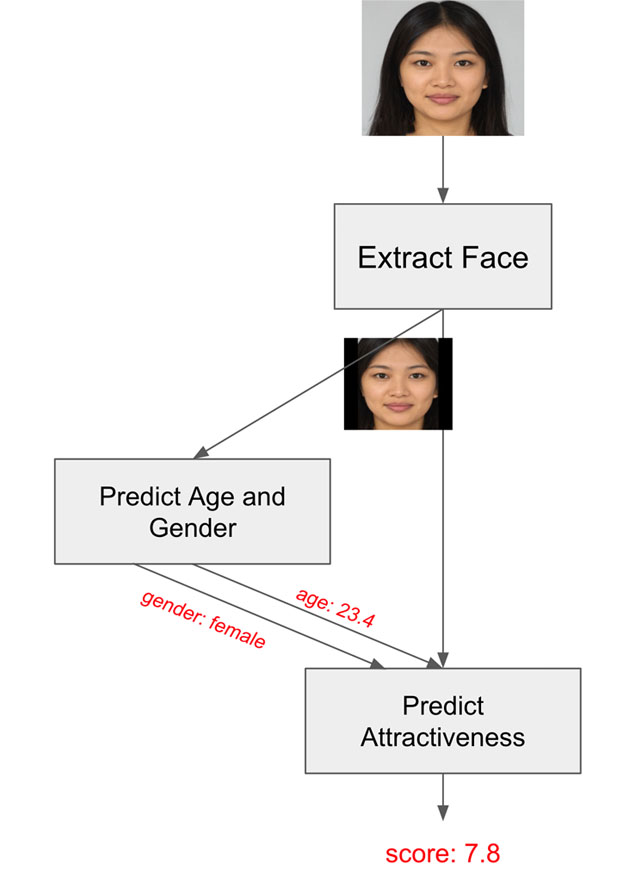
The interesting part happens in three stages. We lean on the face as a whole and on the patterns the model has learned, rather than measuring one feature at a time. For a longer walk-through, see our how it works post.
Pulling the face out of the photo
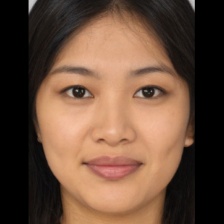
Before anything else, the model has to find the face and crop it cleanly away from the background. Lighting, framing and whatever is going on behind you should not move the score, so this step strips all of that out and aligns the face the same way every time. That consistent starting point is quietly what makes everything after it reliable.
Mapping it as a mesh of keypoints
The cropped face is then covered in a dense mesh of around 400 keypoints that trace the eyes, brows, nose, lips and the line of the jaw. The same idea drives real-time face tracking research, and it hands the model a stable description of structure and proportion, one that holds up from one photo to the next even when the camera angle shifts a little.
Scoring it with a trained network
Finally the aligned face and its geometry pass into a deep neural network. It was trained on a large set of faces that real people had already rated, and along the way it picked up the subtle patterns behind how we tend to judge a face. Once trained, it can give a steady score to faces it has never seen, weighing everything together instead of grading single traits like nose width on their own, because so much of what reads as attractive comes from how the features sit in relation to one another.
What attractiveness affects in real life
It is tempting to insist that looks should not matter. The evidence is less idealistic. Economists who follow the same workers for years keep finding a quiet beauty premium in pay, where more attractive people earn a little more and less conventionally attractive people earn a little less, and the gap holds up even after you account for skill, schooling and family background.[2][3] For any one person the difference is small, but stretched across a career it turns into real money.
The same tilt shows up in our private lives. When researchers picked through hundreds of thousands of choices on an online dating site, a person's photo was by far the strongest predictor of who got a message back.[4] And first impressions reach well past romance. There is a stubborn halo effect in which attractive faces are assumed to be more capable, more honest, even better students, whether or not that holds up in the end.[5] None of this is fair. It is simply part of why so many of us quietly wonder where we stand.
How much is genetic, how much can change
Sooner or later everyone asks the same thing: is any of this in my control? Part of the answer is written in your genes. Large twin studies put the heritable share of facial attractiveness somewhere around half to two thirds,[11] and a genome wide scan has gone further, flagging specific stretches of DNA tied to it, with notably different patterns for men and women.[12] So the underlying architecture of a face is partly inherited, in much the same way height is.
That is only half the story, and the better half is encouraging. Skin condition, body fat, grooming, sleep, posture and the photograph itself all move the needle on how a face reads, and every one of them is something you can act on. Genetics sets the range. What you do inside that range is, to a real degree, up to you.
Is attractiveness objective or subjective?
So, settled at last: objective or subjective? The honest answer is both, and it is not a dodge. Hand people the same set of faces and their ratings agree far more than the old line about the eye of the beholder suggests, and that shared agreement is the objective signal a model can learn. Yet your own history, your mood, the culture you grew up in, all of it still shapes who you find appealing, and no algorithm will ever fully capture that.
The sensible way to read a score, then, is as one informed opinion pulled from many, not a final verdict. It estimates how a typical viewer might react to a particular photo on a particular day. That is genuinely handy when you are choosing a profile picture, and it is also worth holding lightly.
References
- Fiala, V., et al. (2021). Facial attractiveness and preference of sexual dimorphism: A comparison across five populations. Evolutionary Human Sciences, 3, e38. [Link]
- Sierminska, E., & Singhal, K. (2023). Does it pay to be beautiful? IZA World of Labor. [Link]
- Facial Attractiveness and Lifetime Earnings: Evidence from a Cohort Study. Review of Economics and Statistics (2015), 97(1), 14-28. [Link]
- Hitsch, G. J., Hortaçsu, A., & Ariely, D. (2010). What makes you click? Mate preferences in online dating. Quantitative Marketing and Economics, 8(4), 393-427. [Link]
- Talamas, S. N., Mavor, K. I., & Perrett, D. I. (2016). Blinded by Beauty: Attractiveness Bias and Accurate Perceptions of Academic Performance. PLOS ONE, 11(2), e0148284. [Link]
- Jenkins, R., White, D., Van Montfort, X., & Burton, A. M. (2011). Variability in photos of the same face. Cognition, 121(3), 313-323. [Link]
- Bryan, R., Perona, P., & Adolphs, R. (2012). Perspective Distortion from Interpersonal Distance Is an Implicit Visual Cue for Social Judgments of Faces. PLOS ONE, 7(9), e45301. [Link]
- Kartynnik, Y., Ablavatski, A., Grishchenko, I., & Grundmann, M. (2019). Real-time Facial Surface Geometry from Monocular Video on Mobile GPUs. CVPR Workshops. [Link]
- Boukhari, D. E., et al. (2025). A comprehensive review of facial beauty prediction using deep learning techniques. Engineering Applications of Artificial Intelligence. [Link]
- VM-BeautyNet: A Synergistic Ensemble of Vision Transformer and Mamba for Facial Beauty Prediction (2025). arXiv preprint. [Link]
- Mitchem, D. G., et al. (2014). Estimating the Sex-Specific Effects of Genes on Facial Attractiveness and Sexual Dimorphism. Behavior Genetics, 44(3), 270-281. [Link]
- Genome-wide association study reveals sex-specific genetic architecture of facial attractiveness. PLOS Genetics (2019). [Link]
Curious where you land?
Now that you know what sits behind the score, you can try it on your own photo. It is free, and your picture is processed and then dropped, never stored.