What It Measures
The test locates both pupil centers and cheek-edge landmarks, then calculates the interpupillary-distance to face-width ratio.
Discover your interpupillary distance (IPD) with our AI-powered measurement tool. Simply upload a front-facing photo and receive accurate IPD measurements along with your eye spacing ratio in just seconds.
Your marked result appears here
The overlay will show facial landmarks and measurement guides.
Analysis failed
Please try again with a clearer front-facing photo.
Interpupillary distance measures the space between the pupils relative to overall face width. It describes how widely or narrowly the eyes are placed within the face. The ratio is normalized so it can be compared across different face sizes.
Based on 1564 analyzed faces in the reference sample.

Attractiveness AI
Go beyond this result
Explore 50+ facial-feature insights and get personalized recommendations designed to help you look and feel your best.


The test locates both pupil centers and cheek-edge landmarks, then calculates the interpupillary-distance to face-width ratio.
The measured ratio is shown against a reference range so you can see whether your eye spacing is close-set, average, or wider-set.
Look straight at the camera with both eyes visible. Avoid strong side angles, heavy shadows, or glasses that hide the pupil centers.
See how this measurement is distributed across the reference sample used for facial analysis.
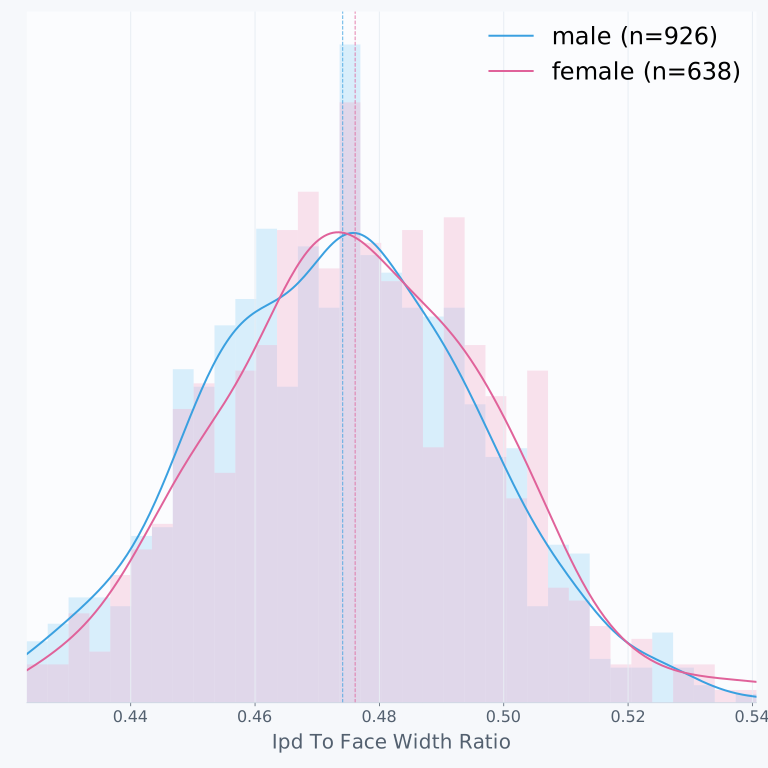
Interpupillary distance (IPD) is the measurement between the centers of your pupils. This measurement varies from person to person and plays an important role in vision correction, eyewear fitting, and virtual reality headset calibration.
Our AI analyzes facial landmarks in your photo to precisely locate the center of each pupil. It then calculates the distance between them and compares this to your face width to determine your eye spacing ratio.
Eye spacing is typically described as close-set, average, or wide-set based on the ratio of IPD to overall face width.
Eyes positioned closer to the nose bridge, with a lower IPD-to-face-width ratio.
The most common eye spacing, considered balanced and proportional.
Eyes positioned further from the nose bridge with greater spacing.
Select a clear front-facing photo from your device.
Our AI locates your pupils and measures the distance between them.
View your IPD measurement and eye spacing ratio instantly.
Knowing your IPD has practical applications beyond curiosity
Ensure your prescription lenses are centered correctly for optimal vision and comfort when ordering glasses online.
Calibrate your virtual reality headset correctly for a clearer, more comfortable, and immersive VR experience.
Understand your facial proportions better. Many people are curious about their unique facial measurements and ratios.
Upload a clear, front-facing photo and get your interpupillary distance measurement in seconds. You will also see your eye spacing ratio and learn how it compares to typical proportions.
Share this IPD measurement tool
Get an instant AI-powered rating of your looks — it's quick, accurate, and free!
Get My Rating